Street Selling
The Purest Form of the Craft
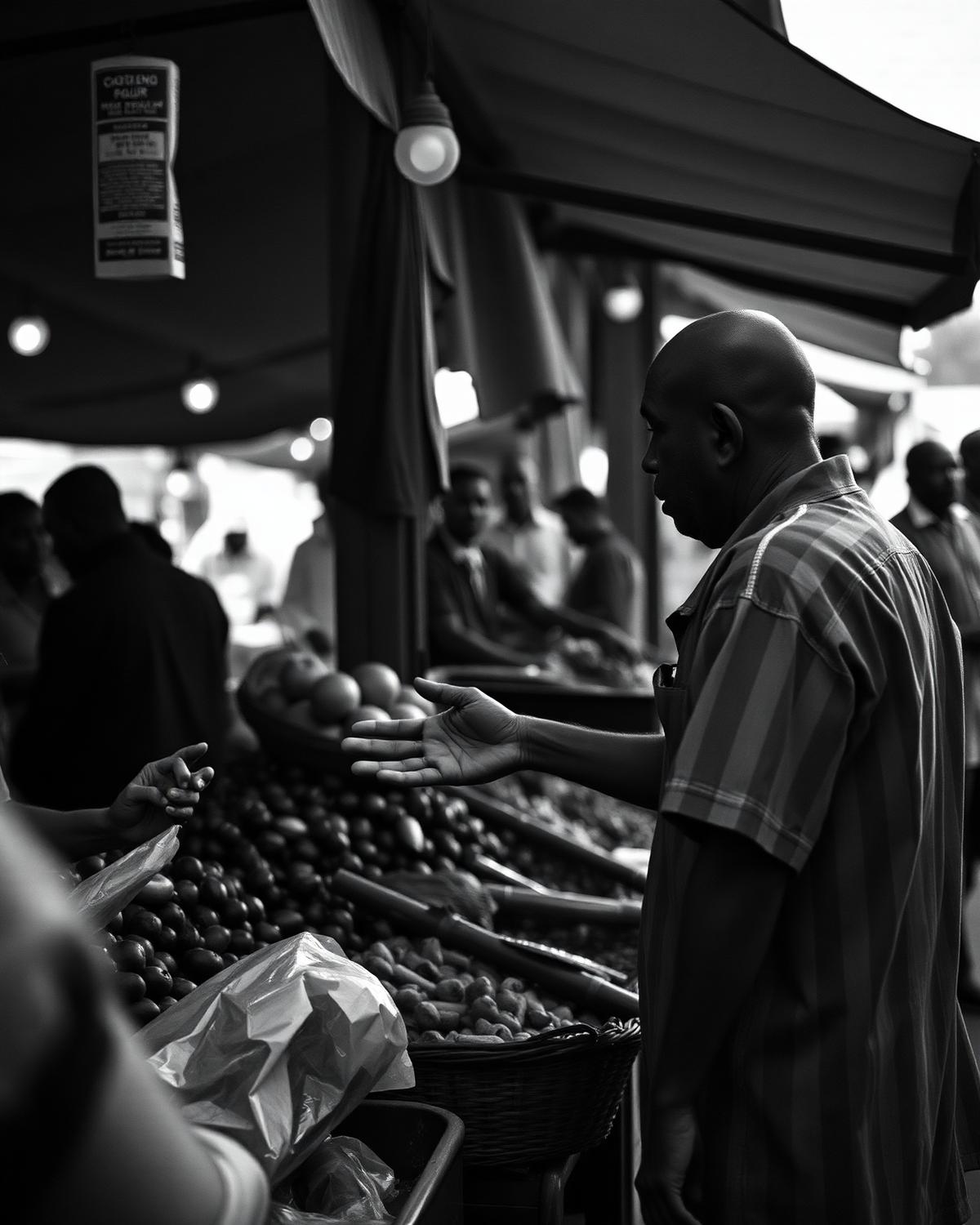
> Remove everything. The CRM, the deck, the salary, the office, the > second chance. What remains is the oldest commercial interaction in > human history: one person, another person, and the space between them.
> Remove everything. The CRM, the deck, the salary, the office, the > second chance. What remains is the oldest commercial interaction in > human history: one person, another person, and the space between them.
In the summer of 2006, I spent six weeks in West Africa as part of a consultancy project studying informal market economies. On a Tuesday morning in Accra, I watched a tomato vendor named Kwame work for forty-five minutes. He sold everything he had --- approximately thirty kilograms of produce. The formally trained representative from a food distribution company stationed twenty feet away, wearing a branded polo shirt and holding a tablet, had spoken to eleven people and closed two in the same period.
The difference was not product quality or price or location. It was Kwame\'s specific, systematic deployment of every major principle of human influence, executed in real time with near-perfect precision by a man who had never read a psychology textbook and who was doing what he had spent years learning through direct observation and constant iteration.
He gave a single tomato to mothers with young children before saying anything about what he was selling --- reciprocity planted before any commercial exchange. He mentioned casually to new arrivals that the woman who had just left had bought the large bag for a family dinner --- social proof, specific and immediate. When he judged that a prospect\'s interest was present but hesitation forming, he mentioned without apparent concern that he did not expect this quality of stock for the rest of the week --- genuine scarcity, communicated without pressure. He remembered names. He asked about family members. He made every transaction a personal interaction between specific people --- liking built systematically into every conversation.
He was, without knowing it, executing the complete framework of Cialdini\'s Influence in real time.
Why Street Selling Is the Best Education Available
The best corporate sales trainers send their teams to street markets. Not as novelty or humility exercises. Because the street vendor has mastered skills that formal environments do not demand and therefore do not develop --- skills that are the actual foundations of the craft, stripped of the infrastructure that normally conceals their absence.
In a formal environment, you usually have the buyer\'s attention by virtue of a scheduled meeting. There is a pipeline, a follow-up email, a recovery call. The immediate interaction does not need to carry the entire weight of the sale. In street selling, there is none of this. Attention is competed for, earned, and maintained against constant competition. This conversation, right now, in the next sixty seconds, is the entire opportunity. That constraint produces a specific and irreplaceable quality of focus: the street vendor cannot afford to misread a buyer, cannot pitch the wrong benefit, cannot waste words. Every element of the conversation must earn its place.
The 15-Second Close
What I observed across vendors in Accra, Nairobi, Istanbul, Marrakech, Ho Chi Minh City, and Mumbai follows a consistent five-part structure:
1. Pattern interrupt (0-3 seconds): something unexpected, vivid, or immediately specific to this buyer. Not a standard greeting --- something that is clearly not being said to everyone on the street.
2. Relevance signal (3-6 seconds): a direct, specific connection to something visible about the buyer --- what they are carrying, wearing, doing, or clearly looking for. Immediate personal relevance.
3. Social proof or scarcity (6-10 seconds): others are buying. This is going quickly. Someone just took the last of this quality. Social validation and urgency simultaneously.
4. The direct ask (10-13 seconds): one clear, simple, frictionless next step. Not a list. Not a further explanation. One specific action.
5. Silence (13 seconds onward): nothing. The next word belongs to the buyer. Always.
That fifth element --- the silence --- is the one most consistently absent in sellers who learned the craft in formal environments. Most sellers are deeply uncomfortable with the pause after an ask and fill it with additional talking that almost invariably introduces new information giving the buyer a reason to hesitate. The seller who makes their ask and then waits, with visible calm, communicates confidence. Confidence is contagious. The first person to speak after the ask almost always concedes something. Hold the silence.
"What I observed across vendors in Accra, Nairobi, Istanbul, Marrakech, Ho Chi Minh City, and Mumbai follows a consistent five-part structure:"
Translating Street Skills to Formal Environments
The disciplines of street selling do not stay in the street. They are the foundations of effective selling in every context. Reading a buyer in the first sixty seconds. Hook before substance. Economy of language. Silence after the ask. Each of these is equally operative in the boardroom, on the phone, in the digital checkout flow. The difference is that in formal environments, their absence is less immediately punishing --- which means their absence is more sustainable and therefore more common.
I run an exercise in my workshops in which participants must sell a simple physical object to a stranger in sixty seconds with no prior research. The exercise is consistently the most uncomfortable activity in the programme and the most instructive. What it reveals, in a controlled environment, is the specific element of the craft each individual is least skilled at --- and that element is almost always the one they most rely on their formal sales infrastructure to compensate for.
> **Key Insight** > > Street selling strips the craft to its irreducible essence: hook, > read, connect, create urgency, ask, wait. Every formal selling > environment requires these same skills. The seller who has developed > them in an environment that demands them absolutely understands the > fundamentals at a depth that no classroom replicates. > > If you want to know exactly how skilled you actually are, find the > nearest market and sell something. What you discover will be the most > honest performance assessment you will ever receive.